



02 Sep When technology and simulation open up new markets
TCN Vehicles Division Srl
Key points
TCN Vehicles Division has evolved from a reality of the mechanical machining of the traditional technology partner for the industry, automotive and motorcycle high range. Thanks to the use of hyperMILL and, in particular, the hyperMILL VIRTUAL Machining, the company has optimised processes, anticipated risks and reduced development time. The simulation is today a strategic lever to increase efficiency, reliability and competitiveness.
Challenge
The increasing complexity of the components, the development cycles getting shorter and the high quality standards typical of the automotive industry, represented a significant challenge. In the validation, late of NC programs in the machine involved collision risks, inefficiencies, and start-up times are longer, especially in a context governed by structured processes such as APQP.

Objectives
The objective was to increase the safety of processes and reduce the time-to-market, validating the NC programs in a complete way, already in the virtual environment. At the same time, TCN aimed to integrate the simulation in the early stages of development in order to anticipate the critical issues and improve collaboration with customers.

Solution and Success
With hyperMILL VIRTUAL Machining, TCN valid and optimizes NC programs even before the production, while reducing risk, time to set-up and movement is not productive. The simulation early allows goodwill safer, cycles, more efficient and more competitive vis-à-vis our customers.
From the artisan experience at the digital innovation
TCN Group was founded in the early 90’s from the entrepreneurial initiative of Joseph Bernocco and Sebastian Astegiano. Started from the micro-enterprises have been able to build over time a group of industrial solid and diversified, able to operate today in most sectors: automotive, precision engineering, industrial automation, food and electric mobility.
Within this ecosystem, industrial places TCN Vehicles Division, with headquarters in Alba (CN), dedicated to the machining of complex components in cold-forged aluminium billet for the automotive and motorcycle high range. The company today represents a reality by about 30 million euro of turnover, with more than 140 employees and a fleet of 30 horizontal machining centers and 12 machines 5 the axes of the latest generation.
Certified to IATF 16949:2016 for the automotive sector , and ISO 14001:2023 for the sustainable management, TCN operates primarily as a provider Tier 1 and Tier 2 groups in italy and europe, industry-leading brands for car and motorcycle, with a strong presence in the machining chassis, suspension components and structural.
“The simulation with the hyperMILL VIRTUAL Machining is not only a collision check, but a tool of optimization of the camera movements, junctions and cycle times, with direct impact on efficiency and profitability.”
The journey with hyperMILL: a choice more and more strategic
Claudio Hair Business Manager had told us to use advanced hyperMILL inside TCN: “Since the beginning of the collaboration with the OPEN the MIND, the features 5 the axes of the solution and CAM have been of great support to solve the needs of the aluminum processing, the need for strategies and performing the request of a speed increase, especially in the early stages of the start of production.”
Over the years, the use of hyperMILL has progressively extended, accompanying TCN the growth of the fleet, the increase of the complexity of the machined components and the need to leverage digital to address some specific strategies.

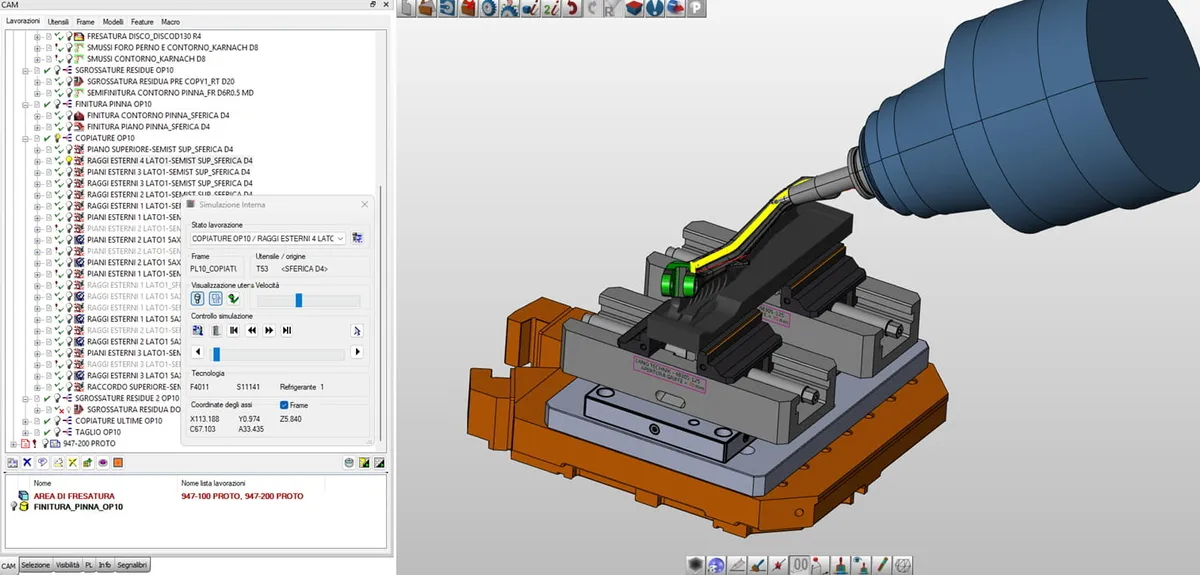
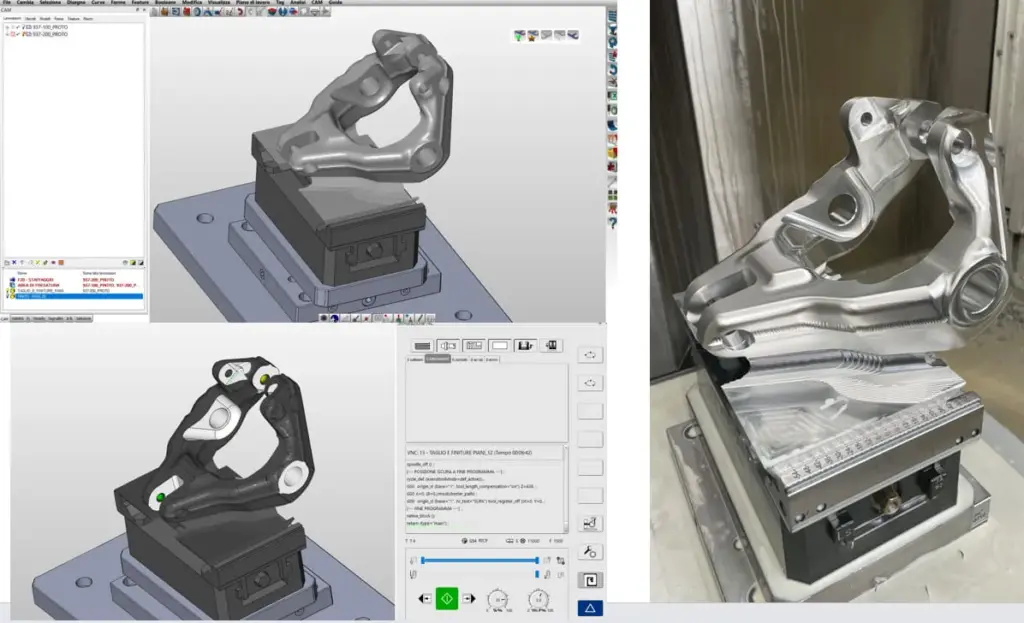
Programming CAD/CAM machining OP 10 support stand motorcycle.


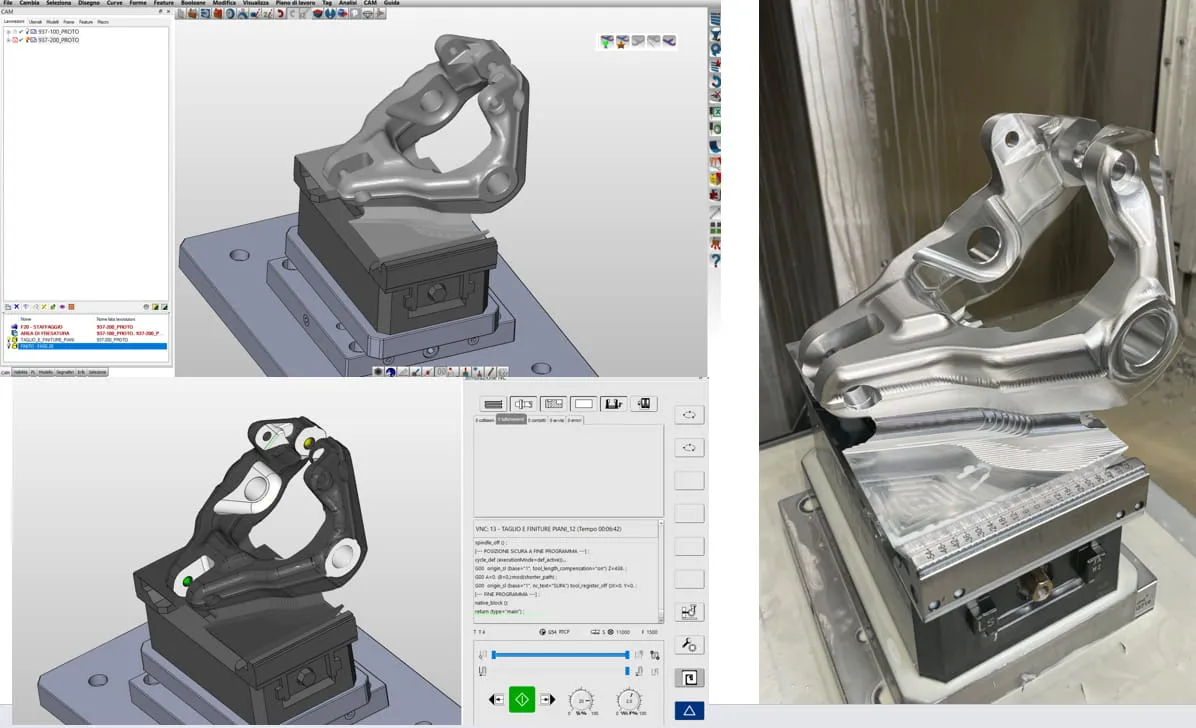
Programming CAD/CAM machining OP 10 support rocker arm motorcycle and view of the manufactured component.
hyperMILL VIRTUAL Machining: anticipate problems to reduce the time
As we said today, Claudio Hair, with Joseph Panetta, Specialist CAM, the most significant change took place in the year 2025 with the introduction of the advanced simulation and hyperMILL VIRTUAL Machining.
It was chosen to invest in a structured manner in the simulation, after a course of assessment and comprehensive testing in which the software was put truly to the test in operating conditions in concrete. As A result of all the tests absolutely positive, it has been confirmed the introduction of hyperMILL VIRTUAL Machining in the production system of TCN.
The objective was clear: once you have defined the CAM program on the equipment and on the work piece, complete all the machining strategies, you wanted to have a tool that can perform post-processing, and automatically generate the machine code compatible with the controls, mainly Fanuc and Siemens, including, in advance of any errors, collisions, and poor efficiency.
As told by Joseph Panetta: “after the generation of the post-processor, the next step takes place inside the simulator, where we can check in advance collisions, the correctness of the tool paths, any inefficiencies kinematics and criticality of the process. This allows us to intervene before you even get in the car, reducing risks and set-up times.”
We add to this the advanced features in optimization managed by the module VIRTUAL Machining, which operates directly on the post-processor. The system is able to automatically optimize the junctions and the movements of repositioning, that is, all those phases in which the machine will not take the chip and therefore does not generate value.
Reduce and rationalise these movements to low-or zero-value-added means to intervene directly on the cycle times, improving the overall efficiency of the production process.
In this way, the simulation is not only a tool of verification, but it becomes a strategic lever to increase competitiveness, reliability and the ability to reduce the processing time in such a way that is measurable and sustainable.

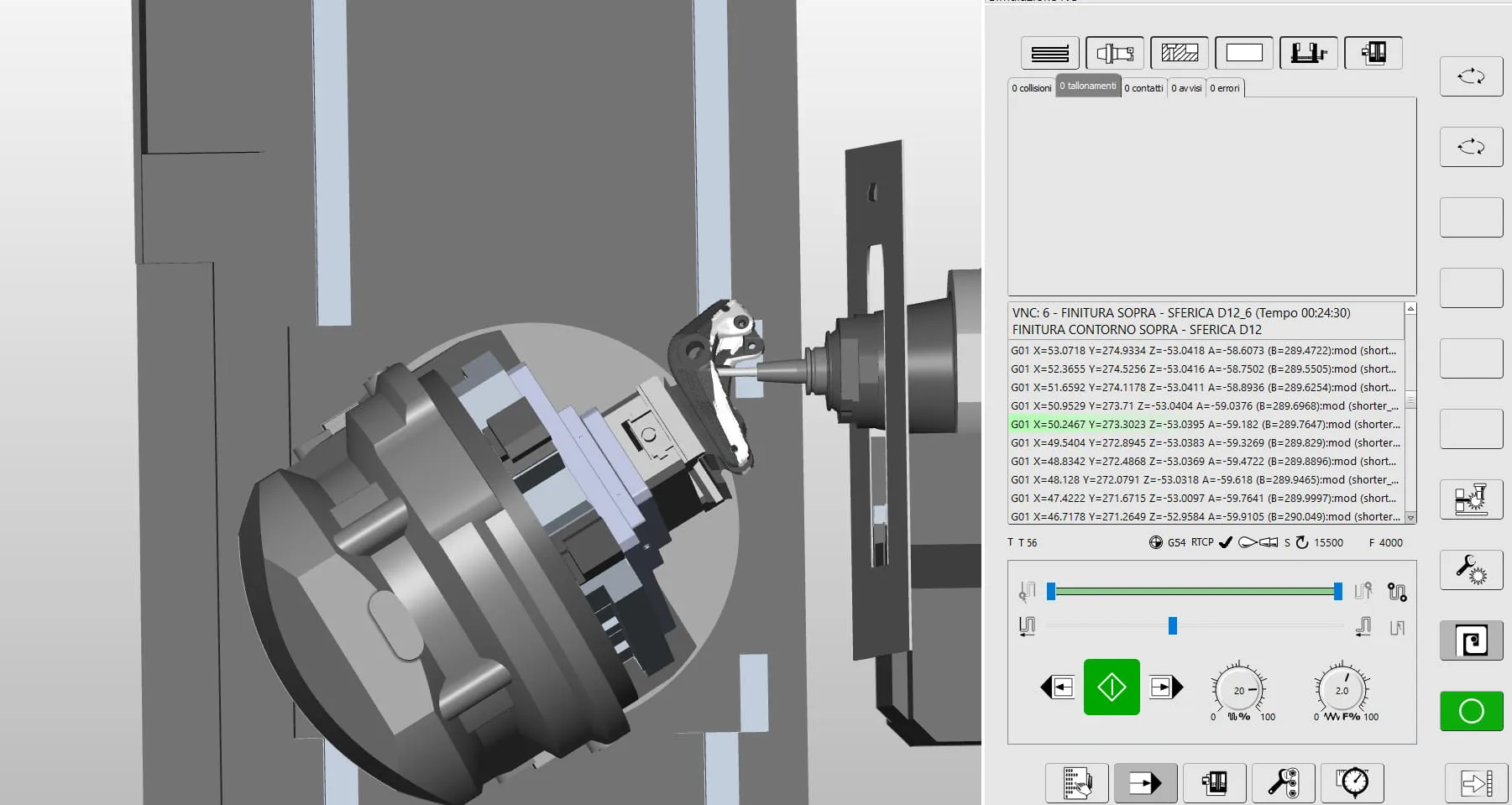
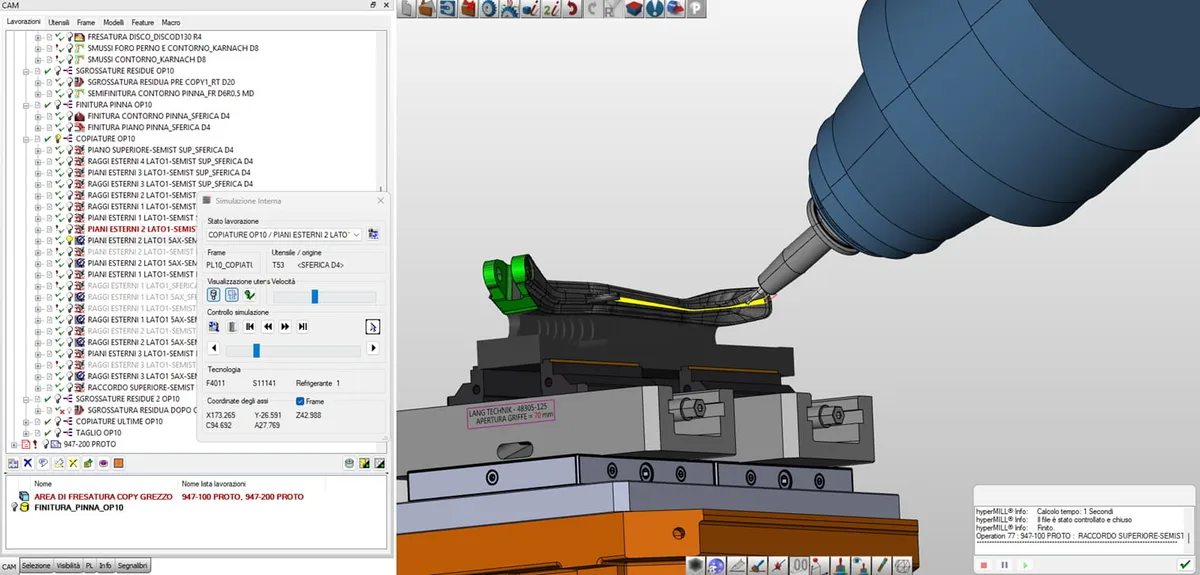
Simulation of the machining OP 10 support rocker arm motorcycle CNC 5 AX GROB G352.
All this is even more important considering that for a company automotive industry, the product development process follows the stages stringent, according to the approach APQP (Advanced Product Quality Planning), the method is structured in 5 stages to ensure the quality in the launch of new products, up in the trial production, and phase SOP (Start of Production).
The typical problem is that the stage of the trial (step 6) is often very close to the start of production, especially in the field of motorcycle where development times are extremely compressed. Thanks to the integrated simulation, possible with hyperMILL VIRTUAL Machining, TCN is able today to anticipate the verification of the collision, optimizing routes, and validation process already in the design phase (step 3), anticipating the activities that were previously carried out only in the phase of final test.
The result is obvious:
• drastic reduction of risks in the start-up,
• greater safety in the respect of deadlines;
• possibility to compress the time for the analysis of critical steps,
• increase of competitiveness vis-à-vis our customers.
As stressed by Claudio’s Hair, “The simulation with hyperMILL VIRTUAL Machining is not only a collision check, but a tool of optimization of the camera movements, junctions and cycle times, with direct impact on efficiency and profitability”. Adds Joseph Panetta “hyperMILL VIRTUAL Machining allows us to have a dialogue with clients, according to one development of the project more quickly, which is reflected on a machine not only faster, but already verified to a level that was impossible before without the help of a simulation, precise and detailed as the one which is able to provide it in this form.”
Prototyping advanced and intervention “step zero”
The involvement of increasingly early in the process the customer, it is now possible, in fact, a TCN to intervene with the client the same even before the commencement of formal project definition stage of the design.
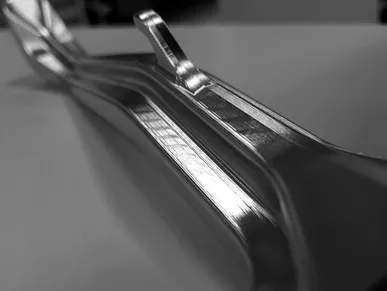
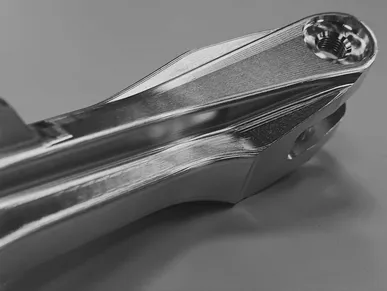
Through strategies of copying and advanced processing 5 aces high surface quality, the company creates functional prototypes and aesthetic finishes that are comparable to those of the final product, and forged. This is particularly relevant in the motorcycle world, where the components must be displayed in the preview or tested in real conditions already in the early stages of development.
The ability to control vibration, strategies to grip the workpiece and the surface finish becomes a distinctive element, made possible by the evolution of the features CAM of hyperMILL.

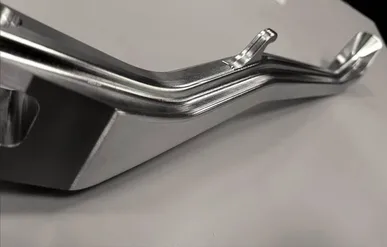
Profiles finished OP20 support stand motorcycle.


A culture of partnership, people-oriented
For TCN technology is central, but not sufficient. The value of the partnership with the OPEN the MIND is recognized, especially in the competence of the people, in the formation applied to real cases, and in the sharing of new approaches.
The training is carried out continuously over the years, the experts of the OPEN the MIND has involved more in-house programmers, consolidating a skilled and creating operational autonomy. Today in TCN approximately six technicians are fully skillati on programming CAM, with levels of specialization are differentiated.
The relationship is not one between the supplier and the customer, but between partners who share a vision with technological and industrial culture.
New markets, new materials, new challenges
After a 2023 complex, sector – automotive, TCN looks to 2026 with a renewed energy. The goal is to further diversify the markets, exploring areas such as the biomedical, defense, naval.
These are areas that share with the automotive industry, the need of machining from solid, high-precision, special materials and quality requirements stringent.
In this scenario, the evolution of strategies CAM, the management of new alloys and the adoption of approaches of processing different, represent a further ground for growth.
An industrial vision that integrates process, technology and strategy
TCN Vehicles Division is not only a machining company, but an organization that integrates design, engineering, simulation, and manufacturing in a flow consistent and certificate.
The progressive adoption of hyperMILL and hyperMILL VIRTUAL Machining has allowed us to transform the CAM from simple programming tool to a strategic lever for the dialogue with our customers at the level of advice, anticipate risks, compress development time, increase reliability, and to support growth on new markets.
The end of Claudius the Hair “In an industrial context in which the speed of development and the certified quality are critical factors, the ability to simulate today what will be produced tomorrow becomes a competitive advantage for concrete”.
For TCN, continuous innovation is not an option: it is an integral part of its industrial identity.